Posts

Showing posts with the label chinese pentatonic

Equal temperament- the Chinese invented it, rejected it and readopted it
Image
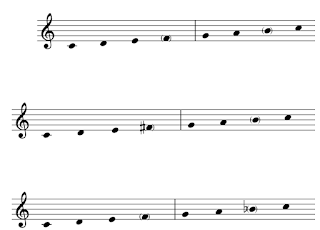
The study of tuning and temperament is a different task since there was no one single method, and case by case there are various of them on different occasions and instrumentations. The worst case, loss in tradition, also happened in China due to wars and invasions. The most popular pentatonic system is based on the ratio of 4/3, multiplies the previous result of 2/3, multiplies the previous result 4/3, and so on. ( link for the calculation detail.) Using this method we get the pentatonic scale and can be further expanded to 12 keys. At the same time, we still met the Pythegroen comma. Based on the backbone of pentatonic, notes can be added between mi-sol and la-do. (see pic) The added notes are in parentheses to form heptatonic (7-note) scales. Chinese opera and small instrumental ensemble trend to use heptatonic scales. 3 common  heptatonic scales in the key of C. In theory, these scales can be transposed to all 12 keys, but the Pythegroen comma is in the way. Many Chinese theor...

Pythagorean - Music of the Spheres vs Guan Zi - Music of earths

Pythagoras discovered musical pitches are ways of vibration. Different intervals of pitches correspond to different ratios of vibration, for example, 1:2 ratios produced an “octave”, 2:3 as fifth, etc. He found new pitches with the ratio of fifth (2:3). Pythagoras saw sound as vibration and motion, to project it to the larger scale planets moving in orbit should also produce a sound. The relative speed of planets response to the certain interval as well. For more info, please visit this article . Similarly, in ancient Chinese philosophy, Guan Zi (c. 720–645 BC) has a view of musical tones related to geography and agriculture in his Diyuen chapter. The way ancient Chinese found pitches was based on a series of adding 1/3 and subtracting 1/3, called subtracting and adding a third method (Sān fēn sǔnyì fǎ).  The starting length is 81 (3^4) namely as "Gong( 宮 )" (do), the soil of Huangtang  黃唐土 The next pitch is 81x4/3= 108 as "Zhi( 微 )" (so), the soil of Heizhi...