Posts

Showing posts with the label chinese music

Partch's ideal musical form -- Japanese musical drama and Chinese opera

Partch portrayed the Greek theatrical art form that weaves poetry, music, acting, and dance into a profound and moving unity, comparing the similarity of Japanese music drama and Chinese opera, to show the ideal corporeal musical form that Partch pursuit. Japanese drama, Noh, from the Japanese social-religious culture, was an amalgam and refinement of the epic recital. Noh developed from and into many forms, the vocal and bodily mechanics of which consisted of dancing, reciting, chanting, and outright singing. Noh eventually brought Kabuki. 'kabuki' can be read as "sing" (歌), "dance" (舞), and "skill" (伎) can be understood as "the art of singing and dancing". The actors mostly focus on acting, gesturing, and occasional reciting. The musical part, singing, and instrumental playing is often played by the onstage ensemble and choir (Actors may sing in Hoh theater, but not as much as we understand in typical opera). The actor and singer are se...

Partch's geniuses of music - Corporeality vs Abstract

Partch's application of just intonation through a system he called Monophony in which all intervals emerge from one fundamental pitch, rhythm and melody have their origin in the spoken inflection of the text, and performance is based on one voice. His elaboration of Monophony means more than the monophonic texture we normally understand.  Partch discusses the origin of music as monophonic songs. It can be traced to all ancient cultures and modern music cultures that still have a strong connection to ancient practice. China had a tradition of poets/musicians positing a strong connection between words and music, the singer and the poet, which is also reflected in his music. The music with lyrics, songs, usually carried concrete ideas or massage. Important ancient and near-ancient cultures-the Chinese, Greek, Arabian, Indian, Africa, in all of which music was physically allied with poetry or the dance and even further cooperate drama and story. It is Partch descibes as Corporeali...

Partch and Cantonese opera

 Cantonese opera, San Francisco, H. Partch, these three things may sound irrelevant at the first glance. However, these three things documented the very first scene of Chinese music exported to America. In California, where Partch was born, living and dead, Gold Rush first lured them in 1848, Chinese immigrants had come to the United States to work. About 175,000 Chinese immigrants who entered San Francisco through Angel Island between the great earthquake in 1906 and the Exclusion Act's repeal of many Chinese in 1943 by the Magnuson Act. The immigrants also brought with them a desire for entertainment from home, a desire musicians and touring companies eagerly filled as Chinatown prospered.  Chinese opera was regaining its foothold in Chinatown in the 1920s; Cantonese opera flourished from this early start until the 1890s and reached its peak in 1920’s. Mei Lanfang and Ma Shizeng toured the United States in 1930 and 1931–32, respectively. Chinese music kept resurfacing throug...

Partch's "17 Lyrics of Li Po" - a set of Chinese poems

Image
Li Po (Li Bai)(701-762)is considered one of the most important poets of the Tang Dynasty and when you study Chinese he is the most known poet, Li Po's work has influenced poets and artists across the world, including Ezra Pound, Gustav Mahler, and Patch as well. His talent was recognized by the emperor. Emperor Xuanzong gave Li Po a position at the Hanlin Academy, where he provided poetry and scholarly advice to the Emperor. However, he did not stay longer than 2 years in the position. Mainly his personality could not work with politics and his poems offended the aristocracy. In the later of his life, wars and rebellions devastate the whole country, he ended up as an alcoholic. His poems are romantic and expressive, at the same time, full of sarcasm to the injustice. Partch's parents had spent the years 1888-93 and 1895-1900 in China as Presbyterian missionaries, exposed to the Chinese culture (Gilmore,1992). Partch's mother even sang Chinese lullabies. It is funny to find ...

Confucius - Chinese ancient thinking of functions of art

Confucius (c. 551–479 BCE) was a Chinese philosopher, poet and politician of the Spring and Autumn period who was traditionally considered the paragon of Chinese sages. What is the intrinsic value of art? Confucius considered poems to have four main functions. Poem is an ancient art form. The ancient Chinese poems were not only for reciting. They can be sung as well, beyond literature, a kind of musical art as well. The first function, enjoyment, is for readers to observe beauty and enjoyment. The second function, reflection, reflects the social or moral problems in society. The third function, empowerment, music as activities gathers people around as emotional exchange. The fourth function, criticizing the social problems. In short, art can educate one and even change society. It demonstrates that the ancient Chinese considered that art is very functional. For music, the concept of lǐyuè ( 禮樂) reflects courtesy and music are closely related.  Courtesy is more than just politeness ...

offset the attack - try not to play together

Image
 In the traditional western music aesthetic of playing in an ensemble, it is important, for every player, to have a unison attack, clear and precise. In a small ensemble, the leader cues the rest of the group; in the orchestra, the conductor gives the precise signal for starting. However, it is not the case in the music of the East. For example, the Chinese opera, the ensemble often closely follows the singer. The time interval is very short enough a quarter of the beat. In Japanese Kabuki music, there is a natural tendency for the voice to sing "out of time" with the shamisen. This is not called a syncopation but rather a form of "neutrality".  Malm, 1963 In both cases, one explanation is that it allows the words to be heard clearly without being covered by the percussion or when all other instruments play a similar melody. Other than the offset attack time, the attack pitch is often not on the accurate pitch, get to the right pitch by bending the note. When changi...

Chou W. C.'s musical calligrapher vs western graphic notation

Image
 Chinese calligraphy calls a double articulation in reference to pictorial art: the vocabulary correlates to the represented object, on the other. For instance, the character for the sun (日)is based on a sequence of brushstrokes that follow a systematic and combinatorial order, while it suggests an actual image of the sun. As a Chinese language user, the picture is inherent in our language which can transpose to composer's notation in Chou's music. Chou is also an accomplished calligrapher. According to Everett (2007), the process of writing the word, the brushstroke in calligraphy, is affecting the look of the character even the same character. Chou treated calligraphic stroke as a type of articulation: with the same note, we can have different articulation to play it, same as brushstroke. The rhythm of music is the speed of a brushstroke. The structure of the character is the texture in music. It has great potential by reading the calligraphy as a score, which echoes the wes...

As one - G. Scelsi's the only pitch method but colourful

Image
The heterophonic texture in Chinese music, with all instruments playing the same melody, have a great effect of combining the timbre of an individual instrument. Since each instrument has its own pattern of harmonic series. In the case of Chinese folk instruments, each instrument sounds quite special and unique. Chinese characterize the instruments into 8 categories: metal, stone, string, bamboo, gourd, clay, leather, wood. When different instruments are combined within the same melody,  This kind of oneness was further expanded to one note. In his Quattro pezzi su una nota sola ("Four Pieces on a single note", 1959) his best-known technique for having composed music based around only one pitch, altered in all manners through microtonal oscillations, harmonic allusions, and changes in timbre and dynamics. With different instruments add-in or drop-out, the timbre is constantly changing even though there is only one note. Similar to heterophony in Chinese music, instruments pla...

The aesthetic of guqin - the idiom of Chou Wen Chung's music

Image
Guqin or qin ( 古琴 ) is a plucked seven-string Chinese zither. Chou music is inspired by qin music. To dig deep into Chou's music understanding its aesthetic is critical. I would use a thesis, The 24 Sprites of Qin  (溪山琴況)  by Xu shangying ( 徐上瀛 ,1582-1662) in 1641 to explain the aesthetic of qin. A picture of qin 7 open strings on qin The origin of qin according to Xu (1641), the myth origin, the deity made qin as a tool to cultivate human beings, to combine one's morals and spirituality. This echoes my previous articles about the function of music in China. Xu organized 24 sprites as the basis of the aesthetic of qin. His thesis is long, people summarised the 4 most important points from his thesis. Harmonious (和), the instrument has to be well-tuned. The primary rule is open strings have to harmonize with each other, then the pressed notes come to secondary. The harmonics and pressed should be referring to each other, which implies that the tuning should fit into the h...

Know thyself - a review of Chou's view of cultural identity of Chinese composer

Image
Know thyself was the most famous first of three maxims inscribed in the pronaos (forecourt) of the Temple of Apollo at Delphi. The original idea of this proverb was about the self-reflection and self-referencing of the person, the inner search of one's identity. In Chou's (2007) article, "Whither Chinese Composers?", he is asking a bigger question, the collaborative identity of Chinese composers. The concept of composer did not exist or inherently developed within Chinese culture before the western composition idea impact every Chinese musician. In China, the performers had great freedom of improvising the existing materials, serving part of composing role, the origin of the materials was not important. The music in China was very functional, pure entertainment, working, ritual service, cultivation, and education, they are all about serving the need then done, without polishing the craftsmanship. The artistic concept did not exist in music, on the other hand, painting...

The notation of guqin - the "missing" dynamic and articulation

In qin notation that I have discussed in the previous article , for either a single pitch or a complete sonic event. Chou (2007) interrupted the qin notation, the components of each ideogram-like symbol specify not only pitch, articulation, timbre, dynamics, and so on, but also additional information such as vibrato or other forms of pitch modification after the articulation.  Chou did not explain how the Jianzipu tablature indicates articulation or dynamics. Since my books about Chinese music have arrived. So I have can explain better. In western notation, we use symbols for articulation like staccato, accent, marcato slur etc; for dynamics, we use text f, p, mf, mp, etc.  The western notates the result. On the contrary, the  Jianzipu notates the   method, no dynamic or articulation is directly notated.  In  Jianzipu   the information in each ideogram contains: which finger on the left hand (at the left upper corner of the ideogram) position of ...

Orientalism - different levels of portraying foreign cultures

Image
Orientalism, things from the East from the European point of view. this word is an umbrella term that is too big to conclude. Like the continent 'Asia' from Turkey to Indonesia, meaning half of the globe. To be specific, I am from the far east cultural circle, China, Japan, Korea, Vietnam, Thailand region that are historically closely connected. There has been a long history of European artists portraying the east, as an easterner, I would like to judge the approaches in music. Ultimately, composers have the creative right to compose what they want, but observing their approach is also a way of learning. Level 1: Just the title In Tchaikovsky's Chinese Dance in Nutcracker Suite, the music hardly find any Chinese music influence, I played this music to my friends who do not have any musical knowledge. If I did not mention the title, they just think this is nice western classical music. The costume design in the ballet may use Chinese design, but musically, completely in West...

Equal temperament- the Chinese invented it, rejected it and readopted it

Image
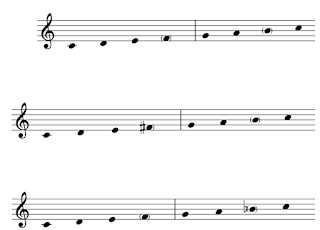
The study of tuning and temperament is a different task since there was no one single method, and case by case there are various of them on different occasions and instrumentations. The worst case, loss in tradition, also happened in China due to wars and invasions. The most popular pentatonic system is based on the ratio of 4/3, multiplies the previous result of 2/3, multiplies the previous result 4/3, and so on. ( link for the calculation detail.) Using this method we get the pentatonic scale and can be further expanded to 12 keys. At the same time, we still met the Pythegroen comma. Based on the backbone of pentatonic, notes can be added between mi-sol and la-do. (see pic) The added notes are in parentheses to form heptatonic (7-note) scales. Chinese opera and small instrumental ensemble trend to use heptatonic scales. 3 common  heptatonic scales in the key of C. In theory, these scales can be transposed to all 12 keys, but the Pythegroen comma is in the way. Many Chinese theor...

53 notes in an octave - go nut, but make sense

Image
Back to the Pythagorean time, when he found notes based on the pure perfect fifth ascending, 3/2 ratio of the original frequency. After conducting it 12 times and bringing it down with 7 octaves. The 13th note is closed to the original notes, it is closed but not off about 23.46 cents (1 cent = 1/1200 an octave), about a quarter-tone. This is known as the Pythagorean comma [(1.5^12)/(2^7)]. (If you really want to see the maths, click here .) People all over the world notice this problem, there are 3 choices for musicians. Completely ignore it, just limit the use of the 5-7 notes in the music, simple harmony and texture, like the music before the renaissance period. Adjust 12 notes we have and the ratios of each interval, with more complex harmony. Meantone temperament - sound pure but some keys are not useable Equal temperament - all keys can be used, but sound the same Unequal (Well) temperament - in between meantone and equal temp. Keep finding new notes with pure 5th or other...

Traditional Chinese notation - the emphasis of the process rather than the result

Image
In Western music, we cannot hear the music by the ancient Greeks since they did not have a system to notate the music before Guido of Arezzo, the development of staff notation in the 10th century.  This also applies to Chinese music. This is an example of the oldest notation of Chinese music in the 7th century. It is a score for guqin (Chinese zither). The notation is text-based ( wenzipu ), telling the performer the playing position (relative pitch) and the playing technique word by word. However, there is no accurate tempo, rhythm, articulation, or tuning. The situation resembles the western staffless neumes. We have the direction but don't know where to start. Listen to the free-flowing rhythm of the example The performance of the score below Text-based notation of Jieshi Diao Youlan The text-based notation is complex, people simplify the notation to tablature ( Jianzipu ) for  guqin in the 10th century .  But the problem of lack of rhythm still was not addre...

Texture and timbre - the beauty of melody

Image
No fancy harmony, counterpoint, chord progression, or modulation, just pure melody. This is the style of traditional Chinese music and Claude Vivier's music. In Vivier's Et je reverrai cette ville étrange, the ensemble always plays in unison or strict parallel motion, monophony, one single melody only. This less-is-more approach emphasis on the timbre of the instruments and the timbre combine. Listen to how different instruments combine together, trumpet, viola, piano, cello, double bass, and percussion. The instrumentation itself is wired enough. Listeners do not have harmony or counterpoint distraction.   Vivier's  Et je reverrai cette ville étrange This approach echoes the aesthetic of Chinese music. Only monophony in music is boring, so through the process of Jiahua (ornamenting the main melody), there is a great deal of interplay, rhythmic variation, and imitative figuration in the parts. The musicians rely on their innate musical sense and skill to create...