Posts

Showing posts with the label bell

The chords from percussion spectra

Image
The harmonic series can generate consonant intervals and even chords from lower harmonic order. Western classical music practice echoes the harmonic series. Percussion instruments are famous for their inharmonicity. In contrast to the common practice, but I follow the same steps by generating chords and harmony from the spectra of inharmonicity. The inharmonicity is due to the irregular shape of an instrument. Standard orchestral-tuned percussion instruments, they can be categorised with the shape of membrane, a bell, a bar and a plate (Dunn et al, 2015). I recorded Here are the chords from the instruments.  Crotales A6 Marimba A4 Tubular bell A3 I picked the strongest partials in the spectra and rearranged them for composition material as the chords below. In my composition for the percussion instruments, the note sets are based on them, the harmony reinforced the spectra (and vice versa) in percussion instruments and escaped from the traditional tonal system idiomatically from th...

Gamelan tuning and instrumental spectra

 There are two major tuning in Gamelan. Slendro scale note 6 1 2 3 5 6 cents 0 231 474 717 955 1208 Pelog scale note 1 2 3 4 5 6 7 1 cents 0 120 258 539 675 785 943 1206 The "scale" concept here is different from the Western. The western scale can modulate or transpose to other keys, like G major scale to D major scale, and the harmonic function. In gamelan, the scale here indicates the fixed set of notes on instruments, and does not implies modulation and harmonic concept. In my theory, I would prefer to call  Slendro "tuning" rather than "scale" to separate the concepts, though scholars use both words to refer to each other. The slendro tuning is similar to a 5-equal temperament. According to Sethares (2010), this pattern lines up with the harmonic partial when an F and G bonang play together, constructing the slendro tuning. The banang is a bell-like metallic instrument. It does not vibrate in harmonic series. That is the reason the octave is off, 12...

Harmonic series vs Inharmonicity - redefining octave in percussion instruments

Image
 When an instrument is played, when put the sound into the spectrum analysis (Fast Fourier Transform), there are multiple tones sounding at the same time, which contributes to the timbre of each instrument. For most instruments, strings, winds, and voice, the frequencies of vibration follow the pattern of harmonic series. Different loudness of individual harmonics contributes to the unique timbre of each instrument. Harmonic series follows the pattern from the whole multiples of the fundamental frequency (f,2f,3f,4f,5f, etc). However, the inharmonic percussion instruments do not follow the harmonic series, thus, this pattern is called inharmonicity. The timbre, as Sethares (2010) describes, is gong-like or bell-like. The spectrum analysis of some iconic orchestral sounds can be found in my previous article . For percussion containing wood or metal bars with free ends, the pattern of harmonic partials is irregular. Sethares (2010) calculated the pattern of the first 6 partials as: ...

Wired harmonic spectra of bells --always out of tune

Image
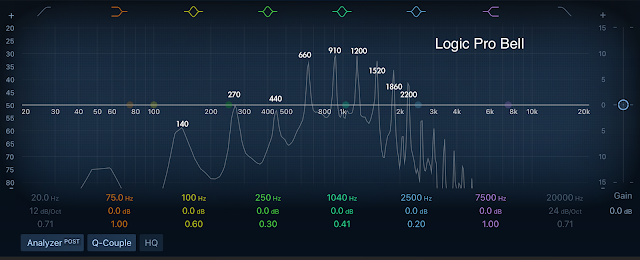
 When a string is plucked the harmonic series fellows an arithmetic progression (f, 2f, 3f, 4f, 5f, ...) (There is an assumption that the string is perfectly smooth and even). However, bells, chimes when they are played, the spectra do not follow the typical harmonic series, because their shape is irregular. The bell makers strive to tune the lowest 5 modes of vibration in the ratios 0.5 : 1 : 1.2 : 1.5 : 2 (Sethares, 2010). Yet, it is just the theoretical model, the tubular bell example below does not follow it. Bell is an instrument that can come in a variety of shapes and sizes. The tubular bell is the most standard one if we really need to find an iconic representative of the bell family. The tube with one end covered shape of a tubular bell resembles the hollow shape of a bell. Here is the comparison of two spectra: a cello and an orchestral tubular bell. Both examples are playing the same note, A3=220Hz. The bell sounds A3 but the spectrum does not appear so and the partials ...