Posts

Showing posts with the label maths

Window Functions in Fourier Transform: Understanding the Role of Observation Time in Pitch Analysis

In the world of music analysis and signal processing, the Fourier transform is a powerful tool for understanding the frequency content of a sound. One of the key components of the Fourier transform is the window function, which controls how long the computer "looks" at the signal in order to determine the frequencies present. In a perfect world, a longer observation time would provide better accuracy in identifying the frequencies present in a sound. However, in the real world, musical notes from instruments are not infinitely long and their sustain is not always perfectly flat and clear. As a result, the pitch of a note can fluctuate, which can lead to a noisy spectrum when analyzing the sound. To address this problem, different window functions have been developed to control the observation time and minimize the impact of pitch fluctuations on the analysis. In music analysis, this principle can be applied to the frequency and time domain of a sound. A commonly used window f...

Exploring the Intersection of cluster in low Register and Heisenberg Uncertainty Principle in Music

When the cluster is played in the low register, the harmonics of notes in the cluster interfere with each other. It creates a complex and muddy sound. The notes can be too close to each other and it can be hard to differentiate them, also the sound produced might be too dense and lack clarity. The low interval limits refer to the range of notes or pitches that are considered to be in the lower register of an instrument or voice. These limits are often established by composers and performers as a guide for creating and playing music in a specific range. For example, a composer may choose to avoid using certain intervals, such as a major third or minor second, below a certain pitch, D3 or E3 respectively, in order to produce a clear perception of an interval. The low interval limits are not hard rules, but more like guidelines, and can be broken depending on the creative intent. Some composers and performers may choose to use lower pitches and intervals in order to produce a specific...

Make a timbre fits 15-ET

Image
This blog article is a snippet of my article, for more info, please visit:  https://docs.google.com/document/d/1LGTcZN83AEFCCjSqfKJOCeIrQKVmdZ8BEUwbBSYOec4/edit?usp=sharing The partial pattern of most strings and wind instruments is in the pattern of harmonic series. In the harmonic series, the 2nd and 3rd partials combine in the ratio of a perfect fifth, 3/2. Stacking the fifth 12 times roughly returns to the original tone in octaves. The 12-ET is the tool to solve the Pythagorean comma. That is the background of why 12-ET fits normal instruments. The challenge right now is I need to build a partial pattern that fit 15-ET. Comparing 12-ET and 15-ET, intervals that line up with each other are major 3rd and octave. Current instruments with harmonic series partials sound really out of tune. The partials have to be rebuilt artificially.  The process of building the partial pattern First, calculate all the ratios of 15-ET. 15-ET 1 1.0473 1.0968 1.1487 1.2030 1.2599 1.3195 1.3819 1...

The amplitudes and time relationship of harmonic number

Image
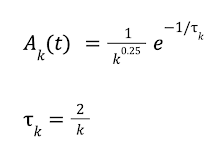
 When a musical note is played, apart from the fundamental frequency, there are overtones above are generated. On a classical string, the harmonic number and time are related.  1.1 A as the amplitude of the frequency. k is the harmonic number. t is time dominant. This also implies that a frequency takes time to vibrate, ringing a note. As time pass, the sound fades out. For any fundamental or overtone, 1.2 For the intensity of the fundamental, it provides about 50% of the power of a note. The next overtone provides about half of the previous etc. resembling as an exponential decay. For a complex soundwave that we hear daily, a tone for an instrument consists of a fundamental wave and multiple overtones. For k is any individual waves, a note can be described as, 1.3 Using cosine function  The cosine function can also be used for expressing a wave by adding the variable e to shift the phase to achieve the same waveform as what the sine function did. 1.4 Fourier Series Since...

Gamelan tuning and instrumental spectra

 There are two major tuning in Gamelan. Slendro scale note 6 1 2 3 5 6 cents 0 231 474 717 955 1208 Pelog scale note 1 2 3 4 5 6 7 1 cents 0 120 258 539 675 785 943 1206 The "scale" concept here is different from the Western. The western scale can modulate or transpose to other keys, like G major scale to D major scale, and the harmonic function. In gamelan, the scale here indicates the fixed set of notes on instruments, and does not implies modulation and harmonic concept. In my theory, I would prefer to call  Slendro "tuning" rather than "scale" to separate the concepts, though scholars use both words to refer to each other. The slendro tuning is similar to a 5-equal temperament. According to Sethares (2010), this pattern lines up with the harmonic partial when an F and G bonang play together, constructing the slendro tuning. The banang is a bell-like metallic instrument. It does not vibrate in harmonic series. That is the reason the octave is off, 12...

A list of Blackwood's diatonic behaviour of equal temperament

 In the succession to the previous article on Blackwood's traditional formation the relationship of a diatonic scale can be written as 5w+2h=n-TET. w, h and n must be an integer and n>w>h>0,, as the diatonic behaviour. I calculated that from 5 to 60-TET by a Python program to see which number of equal temperaments satisfy or not the diatonic behaviour. The table below is the result. If it is labelled as False, it means it does satisfy the diatonic behaviour. If it satisfies, the chart will display number of microstep of a whole tone and half tone respectively. Based on the finding below, we can see that 12-TET is the smallest amount of steps the perform the diatonic behaviour. This is the reason 12 is the most used number. The 35-TET is the last one which does not perform in diatonicly, larger than that, the number are all satisfy diatonic behaviour. The 47-TET is the smallest n-TET can perform bi-diatonic behaviour, 7 microsteps for a whole step and 6 microsteps for a wh...