Posts

The amplitudes and time relationship of harmonic number
Image
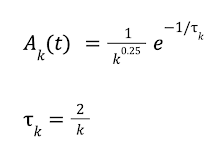
 When a musical note is played, apart from the fundamental frequency, there are overtones above are generated. On a classical string, the harmonic number and time are related.  1.1 A as the amplitude of the frequency. k is the harmonic number. t is time dominant. This also implies that a frequency takes time to vibrate, ringing a note. As time pass, the sound fades out. For any fundamental or overtone, 1.2 For the intensity of the fundamental, it provides about 50% of the power of a note. The next overtone provides about half of the previous etc. resembling as an exponential decay. For a complex soundwave that we hear daily, a tone for an instrument consists of a fundamental wave and multiple overtones. For k is any individual waves, a note can be described as, 1.3 Using cosine function  The cosine function can also be used for expressing a wave by adding the variable e to shift the phase to achieve the same waveform as what the sine function did. 1.4 Fourier Series Since...

The chords from percussion spectra

Image
The harmonic series can generate consonant intervals and even chords from lower harmonic order. Western classical music practice echoes the harmonic series. Percussion instruments are famous for their inharmonicity. In contrast to the common practice, but I follow the same steps by generating chords and harmony from the spectra of inharmonicity. The inharmonicity is due to the irregular shape of an instrument. Standard orchestral-tuned percussion instruments, they can be categorised with the shape of membrane, a bell, a bar and a plate (Dunn et al, 2015). I recorded Here are the chords from the instruments.  Crotales A6 Marimba A4 Tubular bell A3 I picked the strongest partials in the spectra and rearranged them for composition material as the chords below. In my composition for the percussion instruments, the note sets are based on them, the harmony reinforced the spectra (and vice versa) in percussion instruments and escaped from the traditional tonal system idiomatically from th...

Different use of overtone singing

Image
Overtone singing can produce two tones at the same time. The most direct use is the overtone is melody playing, offering a different timbre contrasting to normal singing. The example below is a famous group from Tuva, skip to 00:50 for the overtone singing section. A skilful singer can also provide polyphonic texture with overtone singing. Since there is a second voice in the overtone, the density is thicker. In Tibetan Buddhist chanting, the overtone part is static compared to the melodic contour in Tuvaina. Overtone in Buddhist chanting provides a richer and more resonating timbre. The texture is thicker and wider in regard to the density, thickness, range, or width, between the lowest and highest pitches.

Language of the texts and musical styles of shōmyō

Image
The languages used in shomyo demonstrate the migration of Buddhism, from India via China and settling in Japan, from Sanskrit to Chinese and Japanese.  One type of shomyo language is transcription phonically from Sanskrit. Back in the time, people did not have IPA. People in China used Chinese characters to transcribe Sanskrit phonically. Then, the Japanese pronounce the Chinese transcription in Japanese. In both cases, the phonic transcription is not systematic or accurate. The meaning of original literal meaning of Sanskrit was lost in translation. It is all about the sonic experience, in this case, the texts are often performed in melismatic. On the contrary, the literal translation translates the meaning from Sanskrit, texts were drafted in Japan, and explanatory or narrative in ceremonies are chanted in Japanese and with literal meaning. These texts are meant to be heard, so it is often are performed in syllabic settings. Contour Notation The notation is not that accurate...

How to popularise H. Partch music

 The instruments of H. Partch are unique along with his tuning. However, the instruments are big and hard to transport making his music limited to the physical presence of the instruments. Although recording technology can let the music spread rapidly, the live performance is nonreplaceable. After the COVID, musicians flooded to get back to the track of live performance, which is solid proof.  For composers, if I would like to compose by using the instruments of Partch is also particularly difficult, the unique sound and tuning must be heard by the composer before the composition process. To revive and popularise the music of Partch is more than playing the old recording. Freshwater is needed, composers compose music from Partch's ideology and instruments are the best way to preserve Partch's music. I had an idea of using Partch's instrument to compose, but I found it extremely difficult since the demonstration of each instrument is limited, there are no virtual instruments...

Gamelan tuning and instrumental spectra

 There are two major tuning in Gamelan. Slendro scale note 6 1 2 3 5 6 cents 0 231 474 717 955 1208 Pelog scale note 1 2 3 4 5 6 7 1 cents 0 120 258 539 675 785 943 1206 The "scale" concept here is different from the Western. The western scale can modulate or transpose to other keys, like G major scale to D major scale, and the harmonic function. In gamelan, the scale here indicates the fixed set of notes on instruments, and does not implies modulation and harmonic concept. In my theory, I would prefer to call  Slendro "tuning" rather than "scale" to separate the concepts, though scholars use both words to refer to each other. The slendro tuning is similar to a 5-equal temperament. According to Sethares (2010), this pattern lines up with the harmonic partial when an F and G bonang play together, constructing the slendro tuning. The banang is a bell-like metallic instrument. It does not vibrate in harmonic series. That is the reason the octave is off, 12...

Involution in 12-note system in Western musical culture

 In pop and western classical music, from Bach to today, there are billions of pieces using the 12-note music theory system to compose. From the conservative functional harmony to the modern 4 trichords progress, things do not have big evolved in the field of diatonic. There was a big evolution from the hexatonic to the diatonic system from the middle age to the renaissance period. The transformation from meantone temperament to 12 well and equal temperament from the Baroque period, set the holy grail of 12 notes in an octave and the Twelve-tone technique (dodecaphonism) reached the maximum application of 12. Since the establishment of the 12, there has not been any big evolution. Although composers like E. Blackwood, H. Partch, W. Carlos, L. Harrison, A. Haba etc tried to make different attempts, very few gain public attention. The modern-day problem in the western music system is we are not only stuck in the 12-note system, but also stuck with the traditional functional harm...