Posts

How does AI demolish copyright and where should we go?

Image
An installation for a thought experiment This installation was developed in an application format, where the user enters a text prompt and an image is generated accordingly by artificial intelligence (AI), DALL-E, by OpenAI. The program reads all individual pixels from the machine-generated picture, and the RGB color values are mapped to frequency and played as sound. The experiment is to show which part of the material should I be granted copyright? Rethink artistic creation in copyright With the technology of AI, we have a tool that can generate content easily. In the past, creating content is time and effort-consuming. To acknowledge one’s effort, copyright grants creators of original works exclusive rights to control the use and distribution of their works. These rights are intended to protect the creators' economic interests and to encourage continued creativity and innovation. Recently, the US Copyright Office (2023) issued rules regarding generative AI. The office consid...

Post-spectralism influence on tuning

According to Helmholtz (2011), a musical note is due to the fundamental frequency and the quality of a musical sound is due to the presence of upper partials. For traditional western music, pitch perception is mainly fundamental, rather than the frequencies in the spectrum which Teodorescu-Ciocanea (2003) describes as a “note proper” tradition. The spectralism composers shifted the domain from absolute pitches, intervals and chords to the spectrum. Spectral music is a complex approach to timbre, Teodorescu-Ciocanea (2003) classified 9 tendencies and their possibilities in spectral music. To conclude the techniques, tuning the frequencies according to the harmonic series is the major approach; while working with noise, generated digitally and/or extended techniques on instruments, is a sort of timbral dissonance which dilutes the pitch perception of a musical sound. Teodorescu-Ciocanea describes inharmonicity as the combination of frequencies that are not integral multiples of the funda...

Window Functions in Fourier Transform: Understanding the Role of Observation Time in Pitch Analysis

In the world of music analysis and signal processing, the Fourier transform is a powerful tool for understanding the frequency content of a sound. One of the key components of the Fourier transform is the window function, which controls how long the computer "looks" at the signal in order to determine the frequencies present. In a perfect world, a longer observation time would provide better accuracy in identifying the frequencies present in a sound. However, in the real world, musical notes from instruments are not infinitely long and their sustain is not always perfectly flat and clear. As a result, the pitch of a note can fluctuate, which can lead to a noisy spectrum when analyzing the sound. To address this problem, different window functions have been developed to control the observation time and minimize the impact of pitch fluctuations on the analysis. In music analysis, this principle can be applied to the frequency and time domain of a sound. A commonly used window f...

Exploring the Intersection of cluster in low Register and Heisenberg Uncertainty Principle in Music

When the cluster is played in the low register, the harmonics of notes in the cluster interfere with each other. It creates a complex and muddy sound. The notes can be too close to each other and it can be hard to differentiate them, also the sound produced might be too dense and lack clarity. The low interval limits refer to the range of notes or pitches that are considered to be in the lower register of an instrument or voice. These limits are often established by composers and performers as a guide for creating and playing music in a specific range. For example, a composer may choose to avoid using certain intervals, such as a major third or minor second, below a certain pitch, D3 or E3 respectively, in order to produce a clear perception of an interval. The low interval limits are not hard rules, but more like guidelines, and can be broken depending on the creative intent. Some composers and performers may choose to use lower pitches and intervals in order to produce a specific...

Alternative orchestra's commission -- Let's shake the earth

Recently, I received a commission from Royal Birmingham Conservatoire, the alternative orchestra. The instrumentation is:     2 Piccolos 3 Flutes 1 Soprano saxophone 1 Alto saxophone 1 Tenor saxophone 1 Baritone saxophone 3 B-flat trumpets 5 Tubas 1 Piano 1 Harp 1 Guitar 1 Timpani 1 Tam-tam I had a short interview before the concert and helped me rethink the process of composing this piece Qs - Tell us a little about your piece? It is about noise. The clusters are the main material of the music. The cluster in the bass low register creates a muddy and gritty sound; while the cluster in the high register sounds piercing and edgy. Throughout the whole piece, I gradually add the cluster materials layer by layer until the breaking point everything’s messed up and ends with everyone being shaken. Qs -What attracted you to the sound of the Dung Chen? Dungchen is an instrument used in Tibetan Buddhism. It is a long trumpet, it is very long and puts one end on the ground on the ground...

The problem of the definition of microtonality

Microtone is a territory that people like to explore in between the semitone on the keyboard. The prefix "micro-" means small. So we need something to compare in order to say it is smaller. The 12-ET of an octave is a kind of default that we mostly agree with. Western music has a bigger say in music culture.  The definition of microtone from grove music dictionary, there are two major definitions of microtone, one is any musical interval or pitch difference distinctly smaller than a semitone; the other refers to music with intervals markedly different from the (logarithmic) 12th part of the octave and its multiples, including such scales with fewer than 12 pitches (Griffiths et al., 2001). The first definition I am fine with that. But the second definition, for scales with fewer than 12 pitches for example in some Asian tuning like gamelan, does not express the "micro-" idea compared to 12-ET. Calling it non-standard tuning or temperament is better and avoids confus...

Make a timbre fits 15-ET

Image
This blog article is a snippet of my article, for more info, please visit:  https://docs.google.com/document/d/1LGTcZN83AEFCCjSqfKJOCeIrQKVmdZ8BEUwbBSYOec4/edit?usp=sharing The partial pattern of most strings and wind instruments is in the pattern of harmonic series. In the harmonic series, the 2nd and 3rd partials combine in the ratio of a perfect fifth, 3/2. Stacking the fifth 12 times roughly returns to the original tone in octaves. The 12-ET is the tool to solve the Pythagorean comma. That is the background of why 12-ET fits normal instruments. The challenge right now is I need to build a partial pattern that fit 15-ET. Comparing 12-ET and 15-ET, intervals that line up with each other are major 3rd and octave. Current instruments with harmonic series partials sound really out of tune. The partials have to be rebuilt artificially.  The process of building the partial pattern First, calculate all the ratios of 15-ET. 15-ET 1 1.0473 1.0968 1.1487 1.2030 1.2599 1.3195 1.3819 1...

The amplitudes and time relationship of harmonic number

Image
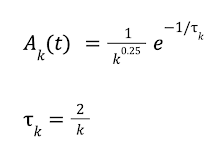
 When a musical note is played, apart from the fundamental frequency, there are overtones above are generated. On a classical string, the harmonic number and time are related.  1.1 A as the amplitude of the frequency. k is the harmonic number. t is time dominant. This also implies that a frequency takes time to vibrate, ringing a note. As time pass, the sound fades out. For any fundamental or overtone, 1.2 For the intensity of the fundamental, it provides about 50% of the power of a note. The next overtone provides about half of the previous etc. resembling as an exponential decay. For a complex soundwave that we hear daily, a tone for an instrument consists of a fundamental wave and multiple overtones. For k is any individual waves, a note can be described as, 1.3 Using cosine function  The cosine function can also be used for expressing a wave by adding the variable e to shift the phase to achieve the same waveform as what the sine function did. 1.4 Fourier Series Since...

The chords from percussion spectra

Image
The harmonic series can generate consonant intervals and even chords from lower harmonic order. Western classical music practice echoes the harmonic series. Percussion instruments are famous for their inharmonicity. In contrast to the common practice, but I follow the same steps by generating chords and harmony from the spectra of inharmonicity. The inharmonicity is due to the irregular shape of an instrument. Standard orchestral-tuned percussion instruments, they can be categorised with the shape of membrane, a bell, a bar and a plate (Dunn et al, 2015). I recorded Here are the chords from the instruments.  Crotales A6 Marimba A4 Tubular bell A3 I picked the strongest partials in the spectra and rearranged them for composition material as the chords below. In my composition for the percussion instruments, the note sets are based on them, the harmony reinforced the spectra (and vice versa) in percussion instruments and escaped from the traditional tonal system idiomatically from th...

Different use of overtone singing

Image
Overtone singing can produce two tones at the same time. The most direct use is the overtone is melody playing, offering a different timbre contrasting to normal singing. The example below is a famous group from Tuva, skip to 00:50 for the overtone singing section. A skilful singer can also provide polyphonic texture with overtone singing. Since there is a second voice in the overtone, the density is thicker. In Tibetan Buddhist chanting, the overtone part is static compared to the melodic contour in Tuvaina. Overtone in Buddhist chanting provides a richer and more resonating timbre. The texture is thicker and wider in regard to the density, thickness, range, or width, between the lowest and highest pitches.

Language of the texts and musical styles of shōmyō

Image
The languages used in shomyo demonstrate the migration of Buddhism, from India via China and settling in Japan, from Sanskrit to Chinese and Japanese.  One type of shomyo language is transcription phonically from Sanskrit. Back in the time, people did not have IPA. People in China used Chinese characters to transcribe Sanskrit phonically. Then, the Japanese pronounce the Chinese transcription in Japanese. In both cases, the phonic transcription is not systematic or accurate. The meaning of original literal meaning of Sanskrit was lost in translation. It is all about the sonic experience, in this case, the texts are often performed in melismatic. On the contrary, the literal translation translates the meaning from Sanskrit, texts were drafted in Japan, and explanatory or narrative in ceremonies are chanted in Japanese and with literal meaning. These texts are meant to be heard, so it is often are performed in syllabic settings. Contour Notation The notation is not that accurate...

How to popularise H. Partch music

 The instruments of H. Partch are unique along with his tuning. However, the instruments are big and hard to transport making his music limited to the physical presence of the instruments. Although recording technology can let the music spread rapidly, the live performance is nonreplaceable. After the COVID, musicians flooded to get back to the track of live performance, which is solid proof.  For composers, if I would like to compose by using the instruments of Partch is also particularly difficult, the unique sound and tuning must be heard by the composer before the composition process. To revive and popularise the music of Partch is more than playing the old recording. Freshwater is needed, composers compose music from Partch's ideology and instruments are the best way to preserve Partch's music. I had an idea of using Partch's instrument to compose, but I found it extremely difficult since the demonstration of each instrument is limited, there are no virtual instruments...

Gamelan tuning and instrumental spectra

 There are two major tuning in Gamelan. Slendro scale note 6 1 2 3 5 6 cents 0 231 474 717 955 1208 Pelog scale note 1 2 3 4 5 6 7 1 cents 0 120 258 539 675 785 943 1206 The "scale" concept here is different from the Western. The western scale can modulate or transpose to other keys, like G major scale to D major scale, and the harmonic function. In gamelan, the scale here indicates the fixed set of notes on instruments, and does not implies modulation and harmonic concept. In my theory, I would prefer to call  Slendro "tuning" rather than "scale" to separate the concepts, though scholars use both words to refer to each other. The slendro tuning is similar to a 5-equal temperament. According to Sethares (2010), this pattern lines up with the harmonic partial when an F and G bonang play together, constructing the slendro tuning. The banang is a bell-like metallic instrument. It does not vibrate in harmonic series. That is the reason the octave is off, 12...

Involution in 12-note system in Western musical culture

 In pop and western classical music, from Bach to today, there are billions of pieces using the 12-note music theory system to compose. From the conservative functional harmony to the modern 4 trichords progress, things do not have big evolved in the field of diatonic. There was a big evolution from the hexatonic to the diatonic system from the middle age to the renaissance period. The transformation from meantone temperament to 12 well and equal temperament from the Baroque period, set the holy grail of 12 notes in an octave and the Twelve-tone technique (dodecaphonism) reached the maximum application of 12. Since the establishment of the 12, there has not been any big evolution. Although composers like E. Blackwood, H. Partch, W. Carlos, L. Harrison, A. Haba etc tried to make different attempts, very few gain public attention. The modern-day problem in the western music system is we are not only stuck in the 12-note system, but also stuck with the traditional functional harm...